© 2021-2026 Perfect in Christ Jesus Life Community. 

Why Did God Reject Saul and Accept David, Even Though Both Committed Serious Sins?

by perfectinchristjesuslife community

One of the most thought-provoking questions in the Bible is:

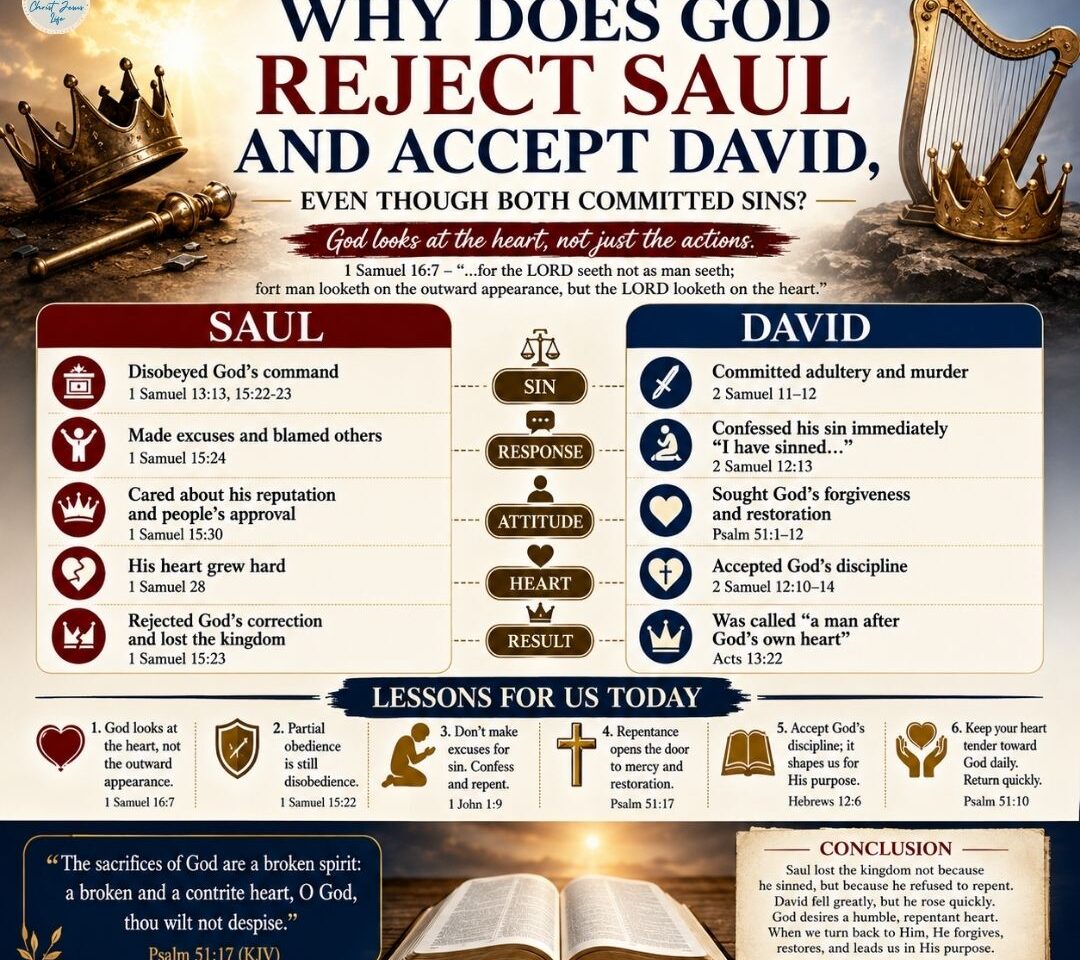
Why was King Saul rejected by God, while King David—who committed adultery and arranged the death of an innocent man—was forgiven and called “a man after God’s own heart”?

At first glance, David’s sins appear far greater than Saul’s. Saul offered an unauthorized sacrifice and spared King Agag and some livestock, while David committed adultery with Bathsheba and orchestrated Uriah’s death (2 Samuel 11).

Yet God removed Saul from the throne and established David’s kingdom forever.

The answer is not that God overlooked David’s sin or judged unfairly. Rather, the Bible reveals that God looks beyond outward actions and examines the condition of the heart.

“For the LORD seeth not as man seeth; for man looketh on the outward appearance, but the LORD looketh on the heart.”
— 1 Samuel 16:7 (KJV)

This truth teaches every Christian that God’s greatest concern is not merely whether we fail—but how we respond when we fail.

God Chose Saul as Israel’s First King

Israel demanded a king like the surrounding nations.

“Now make us a king to judge us like all the nations.”
— 1 Samuel 8:5 (KJV)

God allowed Saul to become king.

Saul had everything people admired:

  • Handsome appearance
  • Great height
  • Military ability
  • Popularity among the people

“From his shoulders and upward he was higher than any of the people.”
— 1 Samuel 9:2 (KJV)

However, outward qualities cannot replace a heart surrendered to God.


Saul’s First Major Failure: Disobedience Instead of Trust
1 Samuel 13 – Offering the Sacrifice Himself

Before battle, Saul was instructed to wait seven days for Samuel.

Samuel delayed.

The soldiers became fearful and started leaving.

Instead of trusting God, Saul acted according to human wisdom.

He offered the burnt sacrifice himself.

Just as he finished, Samuel arrived.

Samuel rebuked him:

“Thou hast done foolishly: thou hast not kept the commandment of the LORD thy God.”
— 1 Samuel 13:13 (KJV)

Saul’s problem was deeper than impatience.

He believed circumstances justified disobedience.


Saul’s Second Great Failure: Partial Obedience

God gave Saul a clear command.

Destroy Amalek completely.

“Now go and smite Amalek, and utterly destroy all that they have.”
— 1 Samuel 15:3 (KJV)

Instead:

  • Saul spared King Agag.
  • Saul kept the best sheep and cattle.
  • Saul justified his actions as religious.

When Samuel questioned him, Saul replied:

“I have performed the commandment of the LORD.”
— 1 Samuel 15:13 (KJV)

Yet he had clearly disobeyed.

Samuel answered with one of Scripture’s most powerful truths:

“To obey is better than sacrifice, and to hearken than the fat of rams.”
— 1 Samuel 15:22 (KJV)

God desires obedience more than religious activity.


Saul’s Response When Confronted

This is where Saul’s heart became evident.

Instead of immediate repentance, Saul:

  • Blamed the people.
  • Defended himself.
  • Made excuses.
  • Tried to protect his reputation.

“The people spared the best of the sheep and of the oxen…”
— 1 Samuel 15:15 (KJV)

Later Saul admitted his sin, but notice what concerned him most.

“Honour me now, I pray thee, before the elders of my people.”
— 1 Samuel 15:30 (KJV)

Saul cared more about public image than genuine repentance.


God Rejects Saul

God declared:

“Because thou hast rejected the word of the LORD, he hath also rejected thee from being king.”
— 1 Samuel 15:23 (KJV)

This rejection was not because Saul committed one mistake.

It was because his life displayed:

  • Persistent disobedience
  • Pride
  • Excuses
  • Fear of people
  • Refusal to fully submit to God

David’s Great Sin

David was called:

“A man after mine own heart.”
— Acts 13:22 (KJV)

Yet David committed terrible sins.

Adultery

David saw Bathsheba.

Instead of fleeing temptation, he pursued it.

2 Samuel 11:2–5


Murder

To hide the pregnancy, David arranged for Uriah to die in battle.

2 Samuel 11:14–17

These were deliberate sins.

David deserved God’s judgment.


God Sends Nathan the Prophet

Nathan confronted David through a parable.

David immediately realized:

“I have sinned against the LORD.”
— 2 Samuel 12:13 (KJV)

Notice the difference.

No excuses.

No blaming others.

No concern for reputation.

Only confession.


Psalm 51: David’s Heart of Repentance

Psalm 51 reveals why God forgave David.

David prayed:

“Have mercy upon me, O God, according to thy lovingkindness.”
— Psalm 51:1 (KJV)

He confessed:

“Against thee, thee only, have I sinned.”
— Psalm 51:4 (KJV)

He desired inward change:

“Create in me a clean heart, O God; and renew a right spirit within me.”
— Psalm 51:10 (KJV)

He understood true worship:

“The sacrifices of God are a broken spirit: a broken and a contrite heart… thou wilt not despise.”
— Psalm 51:17 (KJV)

David’s repentance came from a broken heart—not merely fear of punishment.

Saul vs. David: A Biblical Comparison

King SaulKing David
Chosen for outward appearanceChosen because God saw his heart
Often feared people more than GodDesired to please God above all
Partially obeyed God’s commandsFailed seriously but returned wholeheartedly
Made excuses for sinConfessed sin immediately
Protected his reputationSought God’s mercy
Shifted blame to othersTook full responsibility
Became jealous and bitterRemained teachable and humble after repentance
Lost fellowship with GodRestored through repentance
Kingdom endedKingdom established forever through God’s covenant
The Real Difference: Heart Condition

The Bible never teaches that David’s sins were smaller.

In fact, David’s sins were morally more severe.

The difference was this:

Saul’s Pattern
  • Pride
  • Self-justification
  • External religion
  • Fear of people
  • Selective obedience
  • Hardened heart

David’s Pattern
  • Brokenness
  • Humility
  • Genuine repentance
  • Desire for restoration
  • Love for God’s presence
  • Submission to God’s correction

God Values Repentance More Than Perfection

Every believer will fail.

The question is not:

“Will I ever sin?”

The real question is:

“What will I do after I sin?”

The Apostle John writes:

“If we confess our sins, he is faithful and just to forgive us our sins, and to cleanse us from all unrighteousness.”
— 1 John 1:9 (KJV)

God welcomes those who confess and turn back to Him.


Lessons for Christians Today
1. God Sees the Heart

People may judge appearances, achievements, or reputation, but God examines motives, attitudes, and sincerity.

Proverbs 21:2

“Every way of a man is right in his own eyes: but the LORD pondereth the hearts.”


2. Partial Obedience Is Still Disobedience

Saul obeyed only what was convenient.

God calls believers to complete obedience.

James 1:22

“Be ye doers of the word, and not hearers only.”


3. Never Cover Sin

David tried to hide his sin, but hidden sin eventually comes to light.

Numbers 32:23

“…be sure your sin will find you out.”

The safest response is immediate confession.


4. Repent Quickly

The longer we justify sin, the harder our hearts become.

David’s example teaches us to run toward God, not away from Him.


5. God’s Grace Restores the Broken

Although David faced serious consequences—family conflict, personal grief, and turmoil—God restored his fellowship and fulfilled His covenant through David’s lineage. Ultimately, Jesus Christ, the promised Messiah, came from the house of David.

Romans 5:20

“…where sin abounded, grace did much more abound.”


6. Value God’s Presence Above Position

After his sin, David prayed:

“Cast me not away from thy presence; and take not thy holy spirit from me.”
— Psalm 51:11 (KJV)

David’s greatest desire was not to keep his throne but to remain close to God. As Christians, our relationship with God is far more valuable than status, success, or recognition.


Practical Applications for Daily Christian Living

The account of Saul and David challenges believers to examine their own hearts.

  • When corrected by God’s Word, respond with humility instead of defensiveness.
  • Confess sins honestly rather than hiding or excusing them.
  • Seek God’s approval above the approval of people.
  • Obey God completely, even when obedience is difficult or unpopular.
  • Cultivate a daily life of prayer, Bible reading, and worship to keep your heart sensitive to the Holy Spirit.
  • Extend grace to others, remembering how much God has forgiven you.
  • Trust that no failure is beyond God’s ability to forgive when there is genuine repentance.

A repentant heart keeps us close to God and allows Him to continue shaping us into the image of Christ.


Conclusion

The story of Saul and David is not about one man committing a smaller sin and another committing a greater sin. It is about two very different responses to God.

Saul repeatedly resisted God’s correction. He defended himself, blamed others, and valued his reputation more than obedience. Over time, his heart became hardened, and he drifted farther from God.

David fell into grievous sin, but when confronted, he humbled himself, confessed without excuses, and sought God’s mercy with a broken and contrite heart. Though he experienced painful consequences, he found forgiveness, restoration, and continued fellowship with God.

For every Christian, this is a powerful reminder that God is not looking for flawless people—He is looking for hearts that are humble, teachable, and quick to repent.

No matter how far we have fallen, God’s grace is available when we turn back to Him in sincere repentance.

“The LORD is nigh unto them that are of a broken heart; and saveth such as be of a contrite spirit.”
— Psalm 34:18 (KJV)

May we choose the heart of David rather than the pride of Saul—walking daily in obedience, humility, and wholehearted devotion to our Lord Jesus Christ.

RND from picj community



Leave a comment

Visual Portfolio, Posts & Image Gallery for WordPress
;