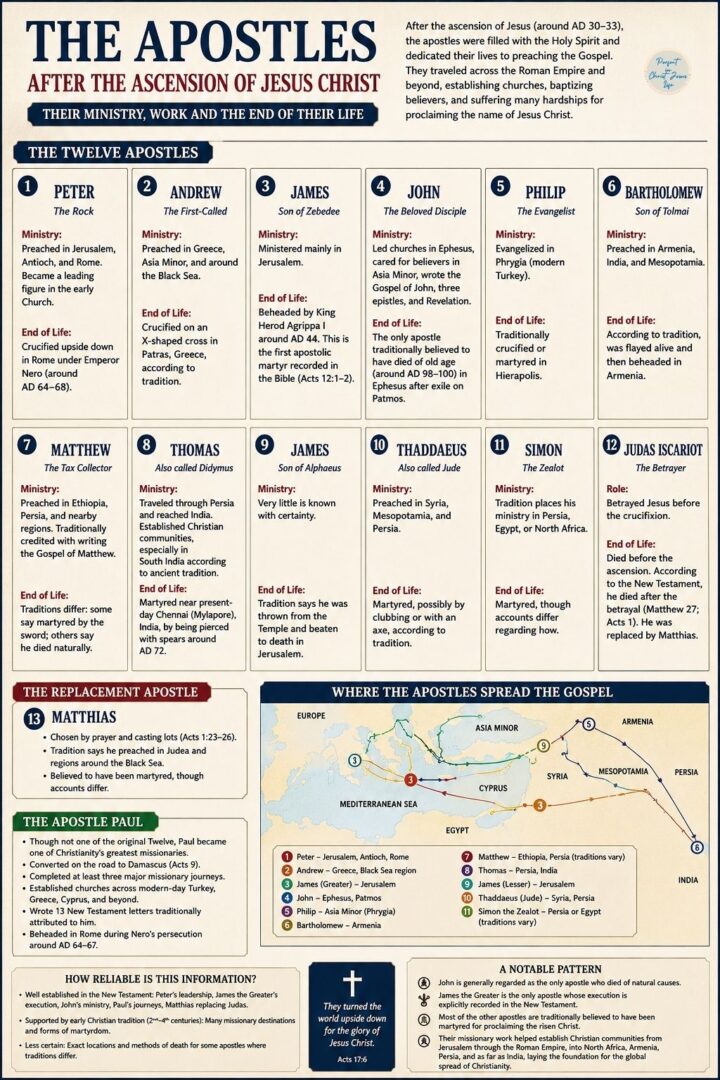
1. Peter (Simon Peter)
Ministry
Peter became the primary leader of the early church after Pentecost.
Highlights of his ministry include:
- Preached the first Gospel sermon (Acts 2)
- Around 3,000 people were saved on Pentecost
- Performed miracles through God’s power
- Opened the Gospel to Gentiles through Cornelius (Acts 10)
- Strengthened churches across Judea and Asia Minor
- Authored 1 Peter and 2 Peter
Peter, who once denied Jesus three times, became one of Christianity’s boldest leaders.
Death
According to early Christian tradition, Peter was arrested during Emperor Nero’s persecution around AD 64–67.
He requested to be crucified upside down because he believed he was unworthy to die in the same manner as Jesus.
His death became a powerful testimony of humility and devotion.
2. John
Ministry
John was known as “the disciple whom Jesus loved.”
He ministered extensively in:
- Jerusalem
- Ephesus
- Asia Minor
He wrote:
- The Gospel of John
- 1 John
- 2 John
- 3 John
- Revelation
His writings emphasize:
- Love
- Truth
- Eternal life
- Christ’s divinity
End of Life
Unlike the other apostles, John was not martyred.
Tradition records that he was:
- Arrested
- Exiled to the island of Patmos
While there, he received the visions recorded in the Book of Revelation.
After returning from exile, he continued teaching until his death from old age around AD 95–100.
3. James (Son of Zebedee)
Ministry
James was among Jesus’ closest disciples.
He witnessed:
- The Transfiguration
- Raising of Jairus’ daughter
- Jesus’ agony in Gethsemane
He preached primarily in Jerusalem.
Death
James became the first apostle to be martyred.
Acts 12:1–2 records that King Herod Agrippa I executed him with the sword around AD 44.
His willingness to die for Christ inspired countless believers.
4. Andrew
Ministry
Andrew, Peter’s brother, was known for bringing people to Jesus.
Tradition says he preached in:
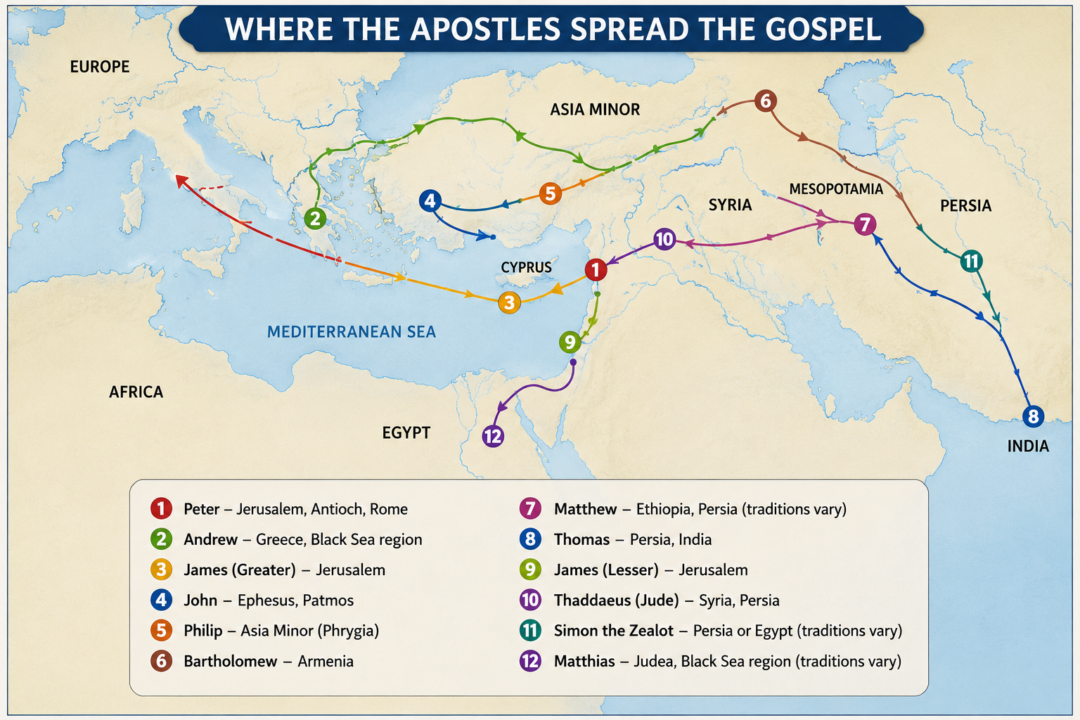
- Greece
- Scythia
- Asia Minor
- Around the Black Sea region
Death
He was crucified on an X-shaped cross.
Tradition says he preached from the cross for two days before dying.
5. Philip
Ministry
Philip preached in:
He proclaimed Christ among pagan communities and established churches.
Death
Early Christian tradition states he was arrested, tortured, and crucified or executed around Hierapolis.
6. Bartholomew (Nathanael)
Ministry
Tradition connects Bartholomew’s missionary work with:
He boldly preached Christ in regions dominated by pagan religions.
Death
Ancient accounts state he was:
- Beaten
- Flayed alive
- Then beheaded
His martyrdom reflects extraordinary courage.
7. Thomas
Ministry
Thomas, once remembered for doubting, became a courageous missionary.
According to long-standing Christian tradition, he traveled to:
Many Christians in southern India trace their spiritual heritage to his ministry.
Death
Thomas was martyred near present-day Chennai, India.
Tradition says he was pierced with spears while praying.
8. Matthew (Levi)
Ministry
The former tax collector became the author of the Gospel of Matthew.
Tradition places his ministry in:
His Gospel presents Jesus as the promised Messiah.
Death
Different traditions vary, but many state he died as a martyr after faithfully preaching the Gospel.
9. James (Son of Alphaeus)
Ministry
Little is recorded about his ministry in Scripture.
Tradition says he faithfully preached in Syria and Persia.
Death
Many early traditions state he was martyred for refusing to deny Christ.
10. Thaddeus (Jude)
Ministry
Jude preached in:
He is traditionally associated with the Epistle of Jude, though scholars continue to discuss authorship.
Death
Tradition says he was beaten and killed while proclaiming Christ.
11. Simon the Zealot
Ministry
Simon traveled extensively, with traditions placing his ministry in:
He proclaimed Christ despite severe persecution.
Death
Ancient traditions differ, but many report he was martyred, possibly by crucifixion or by being sawn in two.
12. Matthias
Ministry
After Judas Iscariot’s betrayal and death, Matthias was chosen to replace him (Acts 1:26).
He continued the apostolic mission and preached in various regions according to tradition.
Death
Traditions differ, but many state Matthias was stoned and later beheaded.
Judas Iscariot
Judas betrayed Jesus for thirty pieces of silver.
Filled with remorse after Jesus was condemned, he returned the money to the chief priests.
According to Matthew 27:5, Judas hanged himself.
His position among the Twelve was later filled by Matthias.
Paul: The Apostle to the Gentiles
Although Paul was not one of the original Twelve, he became one of Christianity’s greatest missionaries after his dramatic conversion on the road to Damascus.
Ministry
Paul established churches throughout:
- Asia Minor
- Greece
- Macedonia
- Rome
He wrote many New Testament letters, including:
- Romans
- Corinthians
- Galatians
- Ephesians
- Philippians
- Colossians
- Thessalonians
- Timothy
- Titus
- Philemon
His missionary journeys transformed the spread of Christianity throughout the Roman world.
Death
According to early Christian tradition, Paul was imprisoned in Rome and beheaded during Nero’s persecution around AD 64–67 because, as a Roman citizen, he was not crucified.